
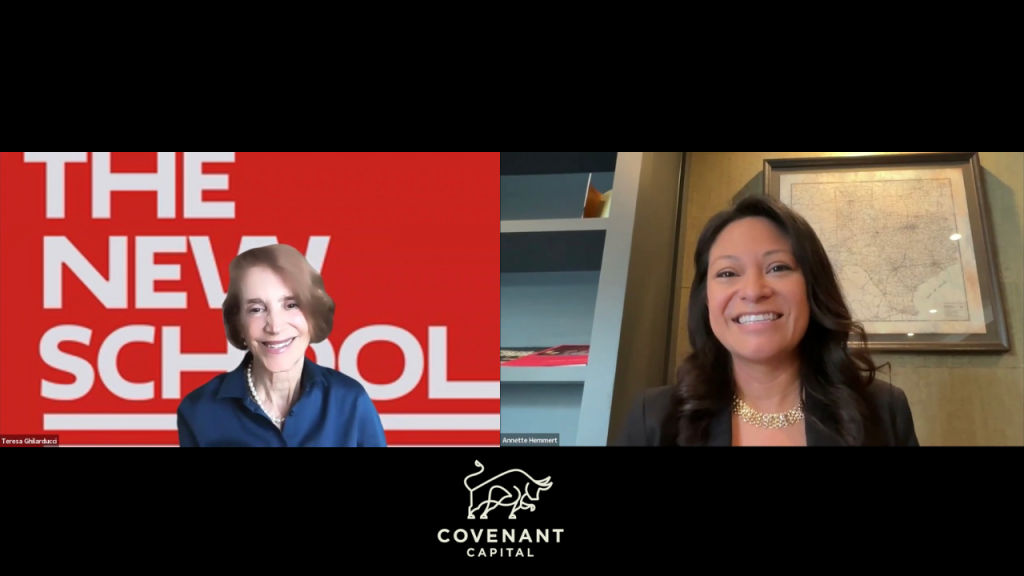
Annette Hemmert
00:01
Here we go. All right. So, welcome, everyone. So excited to have Dr. Ghilarducci here. She’s one of the nation’s leading experts on retirement security. She’s a professor of economics at the New School in New York City.
Where she directs the Schwartz Center of Economic Policy Analysis and the Retirement Equity Lab, and her research focuses on retirement security, pensions, and the future of work.
So you’ve probably seen her on lots of platforms. I first read about her in a Tony Robbins book, which we could talk about later. I read about her there. I’ve seen her, read her work in the New York Times, Wall Street Journal, NPR, PBS, she’s all over the place.
And her research focuses on retirement security, like I mentioned. So it’s a very big, topic today. She’s also gone and testified multiple times in front of the U.S. Congress, and she is the advisor to many, many policymakers on the topic of retirement.
And in her newest book, Work, Retire, Repeat, which is so good, it explores what retirement really looks like in today’s economy, especially as we’re living longer. Longevity is such a big topic today, and also, so is economic uncertainty, so…
I know you, Dr. Gillarducci, you’ve really reshaped the way that I’ve thought about retirement, how I’ve thought about creating wealth, how I’ve thought about, my long-term plan. And so, thank you so much for taking me up on my invitation to be here. I’m so excited to have you.
Teresa Ghilarducci
01:36
It’s a pleasure.
Annette Hemmert
01:38
So let’s start, if I could just be selfish for a minute, because I, like I said, I first read about your work in Tony Robbins’ book, Money Master the Game. That says, after 2008, the financial crisis.
Did you… did he reach out to you? Like, are y’all friends? How did that…
Teresa Ghilarducci
01:58
We’re not friends, but he did reach out to me, because he’s everywhere, all at once.
Annette Hemmert
02:05
Yeah, yeah.
Teresa Ghilarducci
02:06
And we’ve talked, several times, you know, about policies, what can be done about it. I could talk about the kind of legislation, that I’m working on, with, it’s bipartisan, with Democrats and Republicans, but
Let’s build up to that, because the legislation solves a problem when we first have to, like, define the problem for people.
Annette Hemmert
02:29
Sure, sure, sure. So, I know a lot of my audience, a lot of us are millennials, and so we have, we have a pretty unique experience in that we’ve been through
some really significant economic ups and downs between, you know, between September 11th, and then the 2008 financial crisis, and then we went through COVID, and so markets do this, and like, like we mentioned, we talked about earlier, economic uncertainty, so…
Yeah, tell me what, like, some of the biggest problems are, specifically with the 401K.
Teresa Ghilarducci
03:08
Yeah.
Annette Hemmert
03:08
Let’s start there.
Teresa Ghilarducci
03:09
Right. Yeah, so let’s talk about that generation, you know, that cohort. First of all, you’re really not defined by your age as much as you’re defined by your socioeconomic status, you know. So, for some millennials, and for some millennials’ families.
The 2008 crisis was an opportunity to buy cheap assets and watch them grow in 2010, 2011, 2012.
For other people, it meant that they lost their jobs. I mean, unemployment rate was very, very high, 10%. I lived in an apartment building in New York where 8% of the tenants moved out within a month.
So that was… that was amazing, and they were mostly millennials. They had come to New York to make their fortune, and then it was just crashed.
What probably happened is whatever wealth they had built up in their 401K was probably drained, you know, at that moment. And that’s the problem with 401Ks.
in an environment where the market goes up and down, and the peculiar American circumstance where unemployment is the way our economy adjusts. In other countries, the economy goes up and down, but there’s a lot more protection for workers to keep their jobs.
You know, or even to have support,
in their pension system while they’re unemployed. So, people didn’t lose their Social Security credits when the market went down, but they did lose a significant amount of wealth.
And even if you, were down in 2008, but you were at the same place in 2000, you know, 15, let’s say, you still lost a lot, because you lost all that buildup, you know, in 5 years.
So, the problem with 401Ks in a market that goes up and down is that it’s great for people who stay in the market, who do not take the money out, especially when the market crashes because they need it. They don’t have to.
And they still accumulate money, you know, during the business cycle. So what came out of the 2008 recession is a lot of inequality between millennials in terms of their financial security.
Many people were studying now borrowed more money to go back to school during the 2008 financial crisis, because they felt, well, I can’t work, you know, or the labor market’s really bad, so I’ll get an MBA, or I’ll get a master’s degree. Well, they’re still paying that off.
And that’s… and that…
It looks like, because we’re looking at the numbers now, that looks like it takes away from their savings for retirement.
So that’s the problem with the 401Ks, is that the individual bears all the risk, not just of the financial risk going up and down, but bearing the risk that they’ll need that money before retirement.
So… and… and later on, we can talk about, they also bear the risk of living too long. So you bear the market risk, the financial risk, the longevity risk.
Annette Hemmert
06:29
And…
Teresa Ghilarducci
06:30
there are previous kinds of pensions, let’s just say Social Security, the individual doesn’t bear any of that risk. That risk is collectivized. The whole group, you know, bears that risk, and therefore, you can make it smaller, and it’s more dispersed.
Annette Hemmert
06:47
Sure. Yeah, no, thank you for going through that explanation, because I don’t think a lot of people realize that, you know, because I know for me personally, when I entered the workforce, it’s…
like, you go through HR as a young 20-something-year-old, and you go through training, and they’re like, this is it, this is our 401K, we’re gonna give you the match, let’s get you enrolled, you know, that’s just part of the process, and if you…
We’re not taught, like, okay, yes, do this, but also, like, if you’re… if you don’t have the financial literacy, you’re just gonna go with it, because you think that that’s what you do.
Teresa Ghilarducci
07:23
And, you know, if anybody
anybody here has a job with a 401 , you should save in your 401K. I’ll tell you why in a minute.
But for the whole society, I mean, I’m talking to millennials, half of the people who are working now don’t have access to a 401K or any workplace plan.
And economic study after economic study shows that if you could automatically save at work, you know, every paycheck, a little bit goes in, it’s the most effective and most practical way to save for retirement.
So, 401Ks are…
kind of is like a third best solution, but having nothing is, is almost worse. You know, is worse. So having something is better than having nothing at all. And there are ways that people can navigate the 401K so that it, it works
best for you.
Annette Hemmert
08:23
There are other, you know, public policy solutions that will work best for everybody, but for the individual.
Teresa Ghilarducci
08:29
you know, who’s in their 30s, you know, maybe approaching their 40s now, there is a way to handle that 401 .
So, want me to talk about that? I mean, what good strategies would be?
Annette Hemmert
08:42
Yeah, I would love to hear more about what you would say to that, because, you know, as a… because I’m a… I’m a real estate investor, too. I mean, that’s part of what.
Teresa Ghilarducci
08:50
Good deal.
Annette Hemmert
08:51
And so, as a real estate investor, and as someone who brings on other investors to our deals, we talk about multiple streams of income, but not everybody can do that at certain points of their life. There’s a different
season for that, for some people. And so, if the 401K is this
this tool that we can use. Yeah, what would you… what are your recommendations?
Teresa Ghilarducci
09:19
Yeah, you are unusual. You know, I never did what you just did. All of my savings was just in my 403B, which is the educational
The equivalent of a 401 . I never had the guts to go out and invest my after-tax money. I put that after-tax money in a mutual fund.
So I’m impressed already with you. Real estate is difficult because you often own a house in the same geographical area.
that you’re buying your other real estate investments so that you’re putting, kind of, all your real estate money in one geographical, you know, location. So it’s… there’s a risk of your geographical risk. You’re putting all your eggs in one, you know, sort of area. So it’s gutsy to do… to do that.
And you have to really be savvy and know about the real estate market, and I’m sure you’re doing well. But for most of us, we are happy if we’re saving every paycheck, and it’s going into a place that’s well diversified.
And it’s getting about the best risk-adjusted, fee-adjusted return that it can get. So.
You don’t just… most of us just look at the rate of return.
Of a particular investment, and it’s only the past that we can look at. We can’t look in the future. But we forget to adjust it for the risk that you’re taking. So a stock might have gotten 70% last year, like NVIDIA.
And NVIDIA looks like it would be a good deal forever and ever and ever based on its past.
But, but it’s one asset, and it has a lot of risks to go down as far as it went up.
So, the most important thing is to
diversify your portfolio in your 401K by, by asset class. Don’t put all your eggs in one NVIDIA basket.
Annette Hemmert
11:24
industry.
Teresa Ghilarducci
11:24
And the other thing is to really investigate what you’re investing in, in terms of fees. And the best kind of bonds and stock fund to, to invest in is a, is a
fee-only, or, I mean, a index, an index product, like a Vanguard, mostly. It has some of the best products. However.
if you’re in a 401K, Annette, you are at the mercy of what your employer chooses to put into your plan, and so your financial literacy matters, but it’s your employer’s financial literacy that I’m really concerned about.
I’ve seen so many 401K choices that the employer just accepted some kind of consultant’s portfolio.
Annette Hemmert
12:18
And there’s 70…
Teresa Ghilarducci
12:19
options, and they all have names with capital, investment, and growth, and you can’t even tell which ones are stocks or bonds. And so, it, the system puts way… gives way too much leeway to the employer.
And also, the employer has figured out a way to make the employee pay for all of the fees.
So, once they sign you up at HR,
they could care less what you do. They really don’t care. It’s… they sign you up, and then their consultant deals with that. So, the financial literacy is to be able to
Either choose well among the products that your employer gave you, or really pressure your employer to make sure that they have a good bond index fund and a good equity index fund.
Annette Hemmert
13:10
Yeah, absolutely.
Teresa Ghilarducci
13:12
But Annette, what the most important decision people can make is not only where you’re invested, but…
in your decision to accumulate. And that’s two decisions. The first decision is how much to put in.
And Millennials, because of what’s happening to Social Security and other… and housing assets, which means they’re kind of flatlined for Millennials, they might have gone up for other generations, but they’re flatlined for Millennials. The only place you can really get a rate of return is going to be in the financial markets, in your 401 .
Annette Hemmert
13:47
So you’ll probably…
Teresa Ghilarducci
13:49
We’ll… you’ll probably have to save 17% of your paycheck.
on top of Social Security, in order to maintain your living standards for the rest of your life. Because your life is going to be longer.
than other generations. So, the most important decision to make is how much to put in.
And the second important decision to make is whether or not you’re going to keep it in.
So you have to put it in a lot, and you have to keep it in for 40 years.
you do that.
you’ll probably make it, that you won’t run out of money for the rest of your life. But I’m looking at the data, and I’m seeing a very small number of people who are actually able to do that. Because the system is set up
for you to withdraw the money, you know, before retirement, to buy your house, to fund your kids, to get through that unemployment period. Hard to.
It might be financial literacy, but also it’s the kind of the risk that the whole market sets up for people. So I don’t like to blame the victim, you know, for not knowing enough. You’re really… you could know a lot, but you don’t have any choice.
Annette Hemmert
15:01
Right, no, exactly. I love what you said about the risk that, like, it really is put all on the… on the employee, right? All of the fees.
Teresa Ghilarducci
15:10
All of the, you know, the market risk. But then, so, has your…
Annette Hemmert
15:15
Has your… you and your team… have y’all done any research on these target date funds within 401Ks? Because I’m… I’ve read multiple stories about these managers getting, like, lawsuits, and these are big people, like you mentioned Vanguard paid out one, Morningstar…
Teresa Ghilarducci
15:35
I know.
Annette Hemmert
15:35
what’s going on with Target Date Fens? Because that was the initial path that I was led on.
Teresa Ghilarducci
15:42
Yeah, yeah.
Annette Hemmert
15:43
Choose this fund, and you’ll be set in 40 years.
Teresa Ghilarducci
15:47
I know, I… I remember… I remember sitting in Congress
And I was… when you testify in Congress, you’re on a panel. There’s a subject that the legislators want, you know, to understand, and they have about 4 people, you know, to explain it. And this is about 20 years ago, and this expert said.
These target date funds look like a solution to a really hard problem. Like, how does the ordinary person
know what to invest in, and how does an employer know, you know, what choices to give their employees? So, here are these target date funds that, depending on how old you are, we’re going to put you in riskies,
equities by a big percentage, or a big percentage in bonds, depending on how old you are. And it will change as you grow up, and you really don’t have to think about it. It looked great on paper, but what this expert said 20 years ago is that the fees that they’re charging
To do that are absurd.
That’s what the lawsuits are about, that these fees to manage what basically a computer manages.
Are too large.
I’m, so I…
We’ll tell people, pick the target date funds, and make sure your employer tries to bargain down the fees.
Because that’s probably a better portfolio than what an individual is going to choose on their own. It’s amazing how many employees like to have a brokerage account in their 401Ks.
Always. I’ll just say always. Maybe there’s one person where it’s not a mistake, but I’ll just say, I’ll round up to always. 100% a mistake.
You know, because if you are working as an accountant, or a salesperson, or a nurse, you are not going to be able to spend the amount of time to beat the market, and you probably won’t, because the market
has insider information. They move faster than you do. They’re bigger than you do. There’s just no setup where a brokerage account is good. But many, many people think that if they have control, that they can actually do better, which is a human trait.
So that’s… so you just… you just heard a lot of ambivalence about the target date funds. That’s what you heard.
Annette Hemmert
18:17
is that what the Target Day Funds are trying to do.
Teresa Ghilarducci
18:21
is to get people to what’s called an efficient portfolio. But I don’t use it, and I don’t spend all my time, like, looking at the market, probably more time than most people, and I basically do a 60-40.
split. Now, it’s a little bit more conservative as I grow older, but the stock market, you know, has flipped it. So I was at 60% stocks, high-risk stocks.
Annette Hemmert
18:50
diversified all over the, you know, the world. Industry.
Teresa Ghilarducci
18:53
Yeah, and about 40% of Little Bit Real Estate.
mutual funds, you know, but mostly bonds, some guaranteed assets. So, 40% bonds.
And, you know, in general, fixed income. 60% stocks, and it turns out
if you have them in index funds, and you’re not paying very much for the fees, you’ll do just about as well as anybody else. You’ll do just as well as the target date funds, and you won’t pay the target date fees. So, if you’re up to it, I would say to people.
Make sure you save enough.
And then the next thing is diversify your portfolio among a bond fund with low fees and a stock fund with low fees, and you’ll do all.
Annette Hemmert
19:43
Yeah, and I think that’s where, in his book, in Tony Robbins’ book, that’s where you were positioned, in that whole conversation about mutual funds, and how… yeah, it’s just… you take on all the risk in terms of fees, because whether you go up, whether you go down, they’re gonna.
Teresa Ghilarducci
20:01
Yeah, exactly.
Annette Hemmert
20:03
Like, you take on all the risk there.
Teresa Ghilarducci
20:06
Yeah.
You know, because that’s a way, we have a commercial system.
And everybody who manages our money wants to make a buck, even your advisor, so that’s the next subject that we can talk about. Whereas if a public fund
you know, like Social Security, they’re not in it for the profits. You know, they don’t have a board of directors that they have to maximize profits for. And so, if you’re in commercial product, you are… you are…
In a system where.
Annette Hemmert
20:37
it exists to maximize the profits for the shareholders. Sure.
Teresa Ghilarducci
20:43
Vanguard is a little different, a little different, in that their incentive is to either lower the fees for you or to improve the technology, because they don’t have a board of directors. They don’t have shareholders, except for the account holder. They’re the only mutual fund
mutual company out there. So if you’re a shareholder, you’re also a stockholder.
And so they have to maximize, profits for you. And so the… it’s not as conflicted as the other, commercial avenues. I get no money from Vanguard, you know, but… but that’s where I put my money because of the lack of the conflict of interest.
Annette Hemmert
21:25
Sure, sure, they have more of a, what is it, like, fiduciary…
Teresa Ghilarducci
21:29
Yeah, they have a fiduciary responsibility for you, and the other ones don’t. You’re exactly right.
Annette Hemmert
21:34
Yeah, wow. So, like, yeah, so let’s pivot there also, because something else that, I mean, we dumped our financial advisor, my husband and I, years ago.
Because we did not feel that he had a fiduciary responsibility to us, because, I mean, he wasn’t…
He didn’t have that… I don’t know if it’s a certification, he didn’t have that designation, and we felt that he was choosing things for us that did not align with our goals, and maybe were aligned with his compensation.
And so, yeah, tell me about that, like, the…
Teresa Ghilarducci
22:12
Good for you.
Annette Hemmert
22:14
Well, I’ve got a guy, I’ve got an advisor.
Teresa Ghilarducci
22:16
And I’m like…
Annette Hemmert
22:17
What would you say to that? What, what, what warnings might you…
Teresa Ghilarducci
22:22
Yeah, I don’t know if you read my little book, How to Have Enough Money When You Retire, but I have one chapter about… I have this guy, you know, and usually the guy has been recommended by a friend or a relative, and so… and I have a Bloomberg column I really like a lot, and I like to refer… I don’t get any money, you know, for referring it.
But it’s… called, How to Choose an Advisor You Can Trust.
And the first line is, don’t take advice from friends and family. That’s, like, the worst advice. Go to this website and find, conflict-free advisors. These are fiduciaries, and they’re going to charge you a fee.
Just like, going to the doctor.
you charge a fee to the… the doctor gets money from you, or your insurance company. It doesn’t get money from the… from the drug companies, you know, that you… that… of the drug that they recommend.
Wouldn’t that be awful? To, like, know that your doctor says, well, I don’t charge you anything, but I’m going to give you this, I’m going to prescribe this drug, this drug, this drug, this drug, and they get a kickback?
Annette Hemmert
23:37
kickback.
Teresa Ghilarducci
23:38
You would be walking out with, you know, a pharmacy, and that’s exactly what happens when you go to a conflicted advisor, is it says, pick this fund, this fund, this fund, and I’ll get a kickback from that fund manager.
And when an advisor says, well, I don’t really charge you anything, then you know that, you’re paying some other way. So the only advisor to use is one that… and the only one that you can trust.
is a fee-only advisor with the proper certification. And in my article, I discuss the various certifications that you should have, and where you can find a fee-only advisor. And you’re gonna pay, like, to $500 to $1,000 for that initial… for that initial assessment.
And I don’t advise to,
to hire someone to manage your money, especially people who are millennials, right now, you can do it yourself. You know, with that initial advice, it’s going to be what I’m giving you for free. Save at least 17%, and make sure that your money is diversified.
Places where you might need advice.
to kind of slow you down is when you buy that house. You know, there are moments, financial moments, where a third party can help you do some, what we call slow thinking, rather than fast thinking.
Many times, paying for your child to go to a very fancy private school is kind of a fast-think thing. You just… you don’t want to deny your kid anything else, and you’ll mortgage your house.
for when, you know, University of Texas, you know, San Antonio would be, be just as good. Sure.
Or a, you know, a summer abroad. You know, if they need to get out of their, you know, get out of home, you don’t have to have a private school, you know, in Connecticut, you know, to do that. You can do it some other cheaper ways.
And a house… a house purchase, your real estate agent is conflicted as well. They want you to stretch. They want you to buy one more bathroom and one more bedroom. They want you to have a 30-year mortgage, when in fact, you should get a smaller house.
Cheaper house and a 15-year mortgage, or a 10-year mortgage, or even a 5-year mortgage.
Because you’ll pay a lot less interest, and a lot less money to your real estate agent.
Annette Hemmert
26:07
Yeah, yeah, no, absolutely. And so, let’s pivot there, because you said something super interesting that, like, okay.
us as parents, like, I have two children, I do.
Teresa Ghilarducci
26:20
I went.
Annette Hemmert
26:20
I do think fast, thank you, thank you. I do think fast when it comes to them, like, yeah, you know, the whatever, the best, I want the best for them, and I…
It’s interesting, because I have a lot of colleagues, a lot of even investors, a lot of friends who talk about, like, how their parents did so much for them.
They’re in a better financial place than their parents are. And you mentioned… you talk about something called the sandwich generation, which is so… it hits so close to home, because in my family, we all pitched in to take care of my grandparents.
And, you know, I think about my parents now, and, like, what… what financial plan do they have for their longevity? And are my sisters and I going to pitch in for their long-term care?
And I know a lot of people who have these concerns, who are my age, in their 30s and 40s, and even invest… I have an investor who said, you know, I’m gonna invest because I need some alternative income streams to prepare for what I know is coming with my parents.
So, is this… I mean, is this just a local thing? Like, just with… Are you seeing this everywhere?
Teresa Ghilarducci
27:36
I’m glad you, we had a,
we had a big project funded by the Social Security Administration to look at exactly that question. How many women in their… it’s mostly women.
Annette Hemmert
27:48
Can’t…
Teresa Ghilarducci
27:49
Mostly daughters, your sisters, you.
In their 40s and 50s are scrimping on their own retirement savings because their older relatives, even their in-laws, you know, have these unexpected expenses.
And that is because the generation before the millennials, were, aren’t in such a good shape. They lost a lot of pensions, you know, with the decline in unions and a decline in defined benefit plans. They were 50 and 60 when the financial crisis happened.
And so that… that gen… your parents’ generation is actually in a lot more fragility than we ever expected, than they ever expected.
Annette Hemmert
28:32
Hmm.
Teresa Ghilarducci
28:34
Most people live in housing markets where the houses have not gone up.
Annette Hemmert
28:38
Yeah.
Teresa Ghilarducci
28:39
I did a big assessment of places where people could downsize, even if they’re housing… if they’re, you know, their 3-bedroom, 2-bath house.
and they’re in their 70s, where it makes sense for them to sell and then downsize. I was shocked, Annette, that there aren’t very many places where that makes sense.
Annette Hemmert
29:02
Really?
Teresa Ghilarducci
29:02
Older tract houses in dying suburbs are worth a lot less than even a smaller condo in a more desirable, walkable neighborhood.
Annette Hemmert
29:13
Mmm.
Teresa Ghilarducci
29:14
So this idea that even your parents can extract money from their house to live on is surprisingly less promising than before.
Annette Hemmert
29:24
So the sandwich generation…
Teresa Ghilarducci
29:27
Is, you forgot about the other part of the sandwich, and that’s the kids.
You know, so the kids are demanding money, and your parents are demanding money, and all you do is work.
and you try to find the little, jars, you know, in which… or envelopes to put that money. Money for my kids, money for my parents, money for myself. It’s almost impossible, because the competition for that savings dollar is just too great.
what you can do is try to sign your parents up to every single social program that they’re, that they’re eligible for. You might want to have a difficult conversation with your parents about how prepared they are, so that everybody can be prepared.
You might want to clean out your garage, you know, and make a little living quarters.
And then your children, I think you should be hopeful, because
the millennials’ children are a lot more sophisticated than the Millennials were. The millennials took lots of loans, they… they got their… their parents took loans.
And, and they thought that a private school, you know, was just worth every single cent, because you’ll get it back. This generation’s getting a little bit more savvy.
At the new school, you see my background, that’s where I teach and work, and it’s a lovely place that is, giving me and my students a lot of opportunities, but it’s very expensive.
Annette Hemmert
30:59
And…
Teresa Ghilarducci
31:00
When I teach my first-year students, I say, hey, do your rate of return calculations. And a couple of my students go to the state university of New York, or the City University of New York, within one semester of being at the new school. And that’s good. That’s good. We don’t want our students to be impoverished.
Annette Hemmert
31:20
Sure, sure. Wow, that’s good. That’s amazing!
Teresa Ghilarducci
31:25
I know.
Annette Hemmert
31:25
That you walk them through that, because that’s… I mean, that could be a whole other rabbit hole, like, higher education and all of these.
this debt, this crushing debt that so many young people took on, and have taken on for jobs that are… do not have the ROI.
Teresa Ghilarducci
31:44
Exactly. It’s almost like selling a subprime mortgage. Don’t worry, you know, buy this asset, and you’re going to get a rate of return. It’s going to be worth the interest rate, and it just isn’t.
Annette, I have to tell you that our… another recent paper and a dissertation of a very talented student is showing that money, that people borrowed for their schooling
Hasn’t been paid off by the time they’re 65.
And so we’re seeing student debt following them into retirement. Yeah, we were… we were shocked, by that.
Annette Hemmert
32:19
Yes.
Teresa Ghilarducci
32:20
And…
And if you… if it’s a federal loan, your Social Security check can be garnished, if you don’t pay back your student debt from, like, 30 years ago.
So it… and as you would expect, it affects people who didn’t finish college because their student loans are… have no rate of return, you know, because they didn’t get their degree. There’s a lot more of those people than you think.
Annette Hemmert
32:46
Sure.
Teresa Ghilarducci
32:46
So… So it doesn’t…
You know, a lot of people come from families where they never have to take a penny of student debt.
Annette Hemmert
32:54
You know, so…
Teresa Ghilarducci
32:55
Our system…
With all the risks, shifted to people who can least bear it, and people who are in an unlucky situation of having parents that aren’t financially secure as they thought they would be, and you have children whose,
Whose grants and public schooling, you know, isn’t as high as quality as could be, are… are really…
facing… that cohort is facing a lot of inequality, where you were positioned or where you were born determines a lot more than… and what kind of employer you have, whether or not they match, whether you can have a 401K, can really determine what your whole life
Cycle is gonna look like.
Annette Hemmert
33:40
Oh, man, totally, totally. Well, you mentioned Social Security, though, so I don’t, like… I mean, I’m 37, a lot of my peers and I, we don’t really talk about that. A lot of us are, trying to really just front-load our career, move up the ladder, create
Like you said, a diversified portfolio of assets.
And, but Social Security is important because, again, we have our parents who are… may or may not be relying on that later.
And you hear the word insolvency, and you hear the date, you know, 2033 being thrown around. What does insolvency mean, and what does that mean for us planning later?
Teresa Ghilarducci
34:26
Yeah, so…
before the current administration, you know, and the dominance of the Republicans, because this has unfortunately become, like, a Democrat-Republican issue.
All of us in the, in the field said.
you know, pretty soon, they’re going to put more money into Social Security, and we won’t get to insolvency, which means…
That, all benefits overnight will be cut by 24%.
So, it doesn’t mean bankruptcy.
It just means that it can’t pay all the promise.
benefits.
Annette Hemmert
35:08
The total benefit.
Teresa Ghilarducci
35:09
the total benefits only can pay 75% of the benefits. And we thought to myself, that’s unthinkable.
And there are pretty good proposals in Congress to get more money, you know, into the system. I’ve written about that, about how billionaires, you know, are treated in the system as if they make $150,000 a year, or $170,000 a year.
And if you just lifted the cap, they could pay more. There’s lots of other ways that you can bring in more revenue that would be fair and really not economically distorting. But the longer we wait, the more expensive it will be to make Social Security pay out full benefits.
And, if it’s more expensive, it’s going to be more difficult to do. What…
what the political scientists tell us, the people who are pretty wise and know how Congress works, is that we’re going to get right up to the… to the point of crisis, you know, to 2031, 2032, and our taxes will go up.
To pay, because it’s unthinkable that 50 million people will have their income slashed by 25% overnight. So, I want to tell the millennials now that you probably can count on Social Security, and your parents will get what they’re promised.
But you should count on having higher taxes later.
For sure.
The tax rates are impossibly low right now, because we are able to borrow. We, the country, has been able to borrow so much money, and pretty soon, we won’t be able to borrow that much money. There’ll be a limit.
Annette Hemmert
36:54
And so we’ll just have to raise taxes.
Teresa Ghilarducci
36:58
you know, taxes have been very low since the first Trump administration, and they were supposed to expire in 10 years, and the low tax rates got re…
got reinstated, so we’re more and more in debt. So, that might mean a Roth IRA, you know, a Rothifying, you know, your
your savings might make some sense. What I don’t like about Roth IRAs is that they’re IRAs, and I don’t like individual retirement accounts because.
Annette Hemmert
37:28
You don’t have an employer match, that’s one thing.
Teresa Ghilarducci
37:31
They usually have really bad choices. They’re not as… there’s no fiduciary looking after you.
With an IRA, and it’s liquid. I mean, people use the IRA as a bank account. So, if you can have a Roth IRA, contribute to it every month, and completely forget that you have it.
That would be the kind of IRA that I would like. So, to answer your question, Millennials should count on higher tax rates, but probably count that Social Security will be there for them.
Annette Hemmert
38:06
Yeah, that’s… that’s such a great point that you made, too, about, Rothifying. I didn’t know that was a word. Yeah, Rothifying. My… and that’s the thing, too, is, like, I’ve tried to talk to some of my peers about that. My husband and I, we took… we did it with our 401K and our IRA.
Wow, you did already.
And it’s… well, we took a big ol’ tax hit, like, that’s another thing, too, when I tell people, like, how much we had to pay in taxes, because that’s the thing, right? You pay the taxes up front so that it can grow tax-free later, and when you withdraw later in retirement, you don’t have to pay taxes, but it is a big tax hit up front, and when I tell people how much we pay, they’re like, we’re not doing that.
But, like you said, the chances of… R…
The tax rate being lower when we’re in our 60s is, like, zero. It’s negative. Zero.
Teresa Ghilarducci
39:01
It’s pretty close to zero, Rushmore down to zero.
home.
A lot of bad things would happen if it was lower. We wouldn’t have roads, schools, and military. You know, there’s a lot of things would be. So I don’t… that won’t happen.
So, yeah, no, that must have… so you actually took your, your 401K money, your non-Roth IRAs, and you transferred it to the Roth? To a Roth. It was so good that you did it at a younger age. I know people doing it in their 60s.
Because when they’re 70, their tax rate’s gonna be lower, and they’ve had to pay even more money. So the money that you paid is a… is a deal, you know, than what you’d have to pay. And you’re long… you’re… you’re really thinking ahead, and you have a… you have a spouse, you know, who’s a really good financial…
planner. A lot of people don’t… aren’t lucky that they have, you know, a spouse that has the same views about money.
That you do. Often that’s not true, and so a lot in my, in my book on… little book, you know, How to Retire with Enough Money, I do talk about dynamics within a couple.
And the kind of… there’s lots of power relationships in saving for retirement. You’re less powerful than your employer. Your financial institutions are more powerful than you. You know, there’s lots of places where you have to find out where your power is and use it, you know, because.
often stacked against you. But the other power relationship is within the household, and this is just a, you know, a nod to women and men, but I’m going to talk to the women first, is that research shows
That a household, thinks kind of shorter term, and they plan, for when the… when the couple, both of the
Members of the couple are alive.
And they misapprehend how much longer their wife is going to, to live.
And also in couples, often, the male has more power because of centuries of patriarchy. And…
And, and we’ll have more power in terms of
boasting that he knows more, but also has more power in the big consumption decisions. So, it’s really important for a couple to understand that you have to save and spend according to the couple’s lifespan, and also the survivor’s lifespan.
Annette Hemmert
41:41
So you’re really lucky that you have a partner like that.
Super blessed.
Teresa Ghilarducci
41:47
Yeah, and if you aren’t, then there’s a lot of ways to have non-emotional, frank.
conversations, you know, without having to make it a part of your… of your relationship and trust and vulnerability and such. There’s… much… much of the differences are often just education and
Framing, rather than the issues of vulnerability or trust.
Annette Hemmert
42:13
Yeah, no, I love that you… you, wrote a chapter on that in your book, and I’ll be sure to put a link whenever we post and put this around social media, because that is very important, and I think that I… I’m blessed in a way that
when… before I got married, I had to go through premarital counseling through the church, and they were like, y’all need to get on the same page about money.
Teresa Ghilarducci
42:40
Isn’t that… yeah, I… I wish everybody… it’s…
Yeah, I know about that. I used to, I taught at Notre Dame for 25 years.
Annette Hemmert
42:49
Okay, yeah.
Teresa Ghilarducci
42:50
And a lot of my students went through the Catholic Church as, you know, premarital… there’s lots of premarital counseling. So even if you’re not related… exactly, even if you’re not related to a church, try to get that financial counseling together. Have a third person, even after you’re married. I find… I find…
that psychologists are often very anxious about money. I used to write for Psychology Today, you know, a blog for Psychology Today, and it was mostly because psychologists realized that they had to get themselves together.
In order to be able to handle the anxieties of their own clients.
Annette Hemmert
43:27
Oh.
Teresa Ghilarducci
43:29
So this is… this is… this is…
frontal cortex stuff, you know, what you know and how you process. But it’s also back here in the fear section. And, so it’s not just enough to tell people what to do, it’s to deal with their emotions around it as well. And the psychologists know that they have to
Handle their fear, in order to empathize and deal with and moderate the fear of their clients.
Annette Hemmert
43:58
Show up for their clients, yeah, that makes total sense.
Teresa Ghilarducci
44:02
And I always thought that a psychologist should give out coupons to, you know, a non-conflicted financial advisor, you know, on the way out, because so much of what people bring to marriage counseling or to, you know, or to individual counseling is just financial fragility.
Annette Hemmert
44:17
Exactly, exactly. And to your point, yeah, there is a way, and we went through tips
and my husband and I have just figured out each other, how to communicate with each other, too, but a lot of it doesn’t have to be fear-based, you know? It could be fun, it could be dreaming, like, there is so much power in a couple that can come together and become almost like a little mini mastermind. And when you marry well, there’s…
Teresa Ghilarducci
44:43
Yeah, there’s opportunity to just dream and, like.
Annette Hemmert
44:47
And I think that…
Teresa Ghilarducci
44:48
Nice, that’s nice.
Annette Hemmert
44:50
The bigger your dreams, too, because, like, we’re talking about, like, personal retirement right now, we’re talking about not outliving your money, but a lot of people want to leave an inheritance to their children’s children.
And that is a very diff… like, that’s a proverb, but it’s a very difficult thing to do when you really start thinking about the logistics behind it.
Teresa Ghilarducci
45:16
Can I talk about that? I think that’s a really important question, because when people say, I want to leave a legacy, it’s often in the realm of fantasy than real planning. First of all, your children want you to be self-sufficient.
They really don’t, want you to, to spend in order to leave a house, you know, or a vacation house, you know, for them, or to not spend enough.
Because you are, you know, worried about leaving something. And often, the wish for a legacy is often, underneath that, a wish for connection.
That if my… if my children know that I’m leaving something for them, then they know that I’m connected and caring for them.
And that’s just a…
There should be a discussion, you know, about that, with your children, about what kind of connection you have.
It, often, it’s also not real because most people do not inherit anything. Many people are doing the reverse inheritance, meaning they’re giving money to their parents.
Rather than their parents giving to them. And the, the average inheritance
For the bottom 90% is about $25,000.
And the house is often not worth as much as it is. All that stuff that you have in the house is not worth anything.
And so inheritance for most people, is just not an issue. And the real problem with inheritance for millennials, is that sometimes millennials count on
their parents leaving them the house, or count on some kind of fantasy number. You know, and so they don’t have to plan as much, because after all, they’re going to inherit $100,000 or $200,000. The answer here is you probably won’t.
Annette Hemmert
47:15
Wow.
Teresa Ghilarducci
47:16
What my husband and I have done is done our financial planning to do what’s called intervivo transfers, meaning that the money that we give to our children is going to happen while we’re still alive.
Because they… that’s when they need the money. They don’t need the money when they’re 60 or 70 or some uncertain time when we’re going to die. They need to know how much money they’re going to have, and they need to plan for their own financial futures without having this kind of lottery, you know, chicken.
Annette Hemmert
47:49
Perfect.
Teresa Ghilarducci
47:50
So, you know, I think inter… economists have done a lot of research to show that about half of families that have the means give while they’re still alive.
Annette Hemmert
48:01
And the other half.
Teresa Ghilarducci
48:03
have an inheritance, but mainly… but mostly it’s accidental, meaning that they die before, you know, they can use their money. And your parents are probably going to live longer than you think they are, and there probably won’t be any assets. So, if this is a message to millennials, don’t count on it.
Annette Hemmert
48:21
I think that’s great advice. I think that’s great advice, because then, yeah, it puts all the responsibility on you, which is where it should be, anyway.
Teresa Ghilarducci
48:31
Well, it’s the one that you have more control over.
Annette Hemmert
48:35
Exactly.
Teresa Ghilarducci
48:36
succeed. So, just talking to you, because you probably are representative of a lot of your listeners, what do you want to leave your children? A good education and a good…
stability, or do you want to leave them inheritance? What’s… what does legacy mean to you?
Annette Hemmert
48:54
Great question. So, legacy for my husband and I are creating… I mean, as Christians, as followers of Jesus, creating two strong, warriors for Christ. That’s first and foremost. Two strong warriors for Christ, but also making sure that they understand what money actually is.
And so, we do plan on leaving them money, but in some… in a confine… in the confines of a trust. Okay. And so, it’s not, it’s not, like you said, a lottery ticket for our sons.
But as they are young, we are training them up as children to understand that money is just a tool, that really, it’s your life, and you were created, and you were put here on Earth by God in order to serve out a mission, and serve people, and serve Him.
And so, money is just… it’s like a certificate of a job well done. So, it’s service first, and then…
And then, you know, whatever follows in terms of your network or in terms of your compensation.
Teresa Ghilarducci
50:02
Okay, so first, your whole life is dedicated towards, you know, giving to your community, giving service.
But also making sure that you’re secure, because you can’t really do a lot of service, you know, unless you’re financially secure.
Annette Hemmert
50:19
That’s exactly right.
Teresa Ghilarducci
50:20
So, is money… Kind of, more equal security.
For your… that’s what you’re teaching your kids, that if you have enough money, it’s only there so that you can do your other work.
Annette Hemmert
50:33
Yeah, well, money is options, also, so we are very much abundant mindset. We are teaching them abundance, and so… It’s good. We’re not… it’s not bad. Money is not an evil thing. It’s not a… in fact, money is good.
Teresa Ghilarducci
50:48
Yeah.
Annette Hemmert
50:49
Being at Notre Dame, you probably heard the story of, like, Genesis, when God created, the Garden of Eden. He put gold in the garden, and the gold of that land is good. So, there’s all…
like, there’s all these references also in the Bible to money and of it being a good thing, but when it’s not your ruler, money being a good thing because it’s just an instrument of your ability to serve.
Teresa Ghilarducci
51:19
deserve, right?
Annette Hemmert
51:20
So, yeah, it means options, it means stability, but it also means that you, in a very real way, and that’s why, like, I love business, and I love
learning about real estate, because it’s a service… it’s a service-driven industry, and Dr. Ghilarducci, you have… you have income-producing assets, you have these amazing books, and your amazing knowledge and wisdom that you’re…
Transitioning to the next generation, and it’s such a beautiful mission, and so it doesn’t have to be real estate, it could be your knowledge and your wisdom that you’re sharing.
And that’s what we’re trying to instill in our… well, we are instilling in our boys, is that you… you’re here as a vessel for service, and find a way to monetize that. That’s a… that’s a good thing, because that gives you options.
And it gives you the ability to give back… give, to people who need it.
I give back. I give to people who need it.
Teresa Ghilarducci
52:14
That’s such a good set of values, it’s very moving, Annette, it’s very moving.
Yeah, because I didn’t think you were going to say that. I thought you were going… I thought you were going to say, you know, we’re teaching them how to be self-sufficient and, you know, how to, you know, take care of themselves, but it’s much better than that. It’s like, to take care of their world.
Annette Hemmert
52:36
It’s very impressive.
Teresa Ghilarducci
52:38
Hang up.
Annette Hemmert
52:39
Thank you, Dr. Ghilarducci. Well, tell us, I am… I want to be so respectful of your time. Your time is so valuable. You do so much for, for the… you’re… you’re making national impact. You’re making world impact. So, tell…
Tell my audience, where can we stay up to date with your research, and where can we find your books and your periodicals?
Teresa Ghilarducci
53:08
Once you know my name.
Teresa Ghilarducci, you’ll find everything, because I’m the only one I know who’s an economist in the country. It’s like, I’m glad I don’t have Anne Smith, you know? So I, you know, I pop up everywhere, you know, like you said, I,
a right for Forbes. I, I think that’s, it’s really… you can get 5 articles for free a month.
And these are just, like, short articles that are related to, kind of, financial planning. And, and my team at the new school, my researchers are, also issue, issue briefs, so you can find it, Teresa Gallarducci at the new school. We have lots of.
issue briefs, and we’re doing a retirement tracker. You know, we’ll give you the link to that, which is tracking the retirement crisis. What’s happening with Social Security, or the trust in Social Security? What’s happening to the poverty among the elderly? How do we assess that?
to talk about how the goals of children and the goals of the elderly are the same, and we could have a public policy that takes care of both, it’s not one or the other, because there’s a lot of people who believe if you give Social Security, you’re not giving to kids. And it turns out, if you have a nation that has a
a secure social security system, it’s a nation that usually cares a lot for their kids with medical and education. So, actually taking care of vulnerable groups, you know, is what a nation decides to do, and you find out that a nation spends
More… if they spend a lot on the elderly, they’re also spending a lot on the children.
Annette Hemmert
54:48
Children.
Teresa Ghilarducci
54:49
So there’s not… it’s complimentary, not a substitute. I do want to say, just individually, because I know that everyone
has the responsibility to take care of themselves because of our 401 system is that you have a lot of power. You have a power as a consumer
you can decide how much you’re going to spend, and what you’re going to spend it on, and how much you’re going to save. And here, I talk about make sure you’re spending for your needs, not for status.
Because that status spending, that social spending, would just suck you dry, because you’ll never be happy.
The dopamine, in order to get that handbag or car or that bigger house.
is rewarding, but it’s not rewarding in serotonin, which is a feeling of well-being. So, watch those hormones. You know, watch what’s happening to your brain when you decide to consume. You have power there.
You have power as an investor. Don’t, don’t hire people who aren’t on your side to fund… to be your advisor. And invest well, and that means have a very diverse
portfolio, so that your risk is low, and to keep your fees down. That’s why I recommend index funds.
You know, you have, power as a worker.
That you can make sure that your skills are, will be useful for about 40 years.
a lot of people… I see so many people who are in construction in their 30s and 40s, and I see their bodies breaking down, and I realize
they’re busting their bottoms, you know, to make money, but they won’t be able to make money when they’re in their 50s and 60s, and I really get emotional about them. I see women working in long-term care, bending and stooping. I know they won’t be able to do that, you know, for as long as they need to.
So it’s really important to take care of your body, to take care of yourself, to make sure… because you will have to work a lot longer than you probably think you will have to.
You have, you have power as, a voter. It turns out that the federal government is one of your most important financial partners. Your Social Security is worth about $300,000, and your,
And your Medicare is worth about $250,000. So, I don’t care if you’re voting for a left wing, right wing, green wing, blue wing, you know, I don’t care who… what party you’re voting for, but make sure that
lawmaker knows, that you need that financial security. So there’s a lot of… there’s a lot of power that people, have.
Annette Hemmert
57:37
And.
Teresa Ghilarducci
57:39
And… don’t feel…
cowed because you don’t have the education, you do, you know, you know, you have the wisdom to know what you need. And make sure that when you save for retirement, this is the hardest thing to do, that you do it wisely, and you don’t take it out before retirement.
Annette Hemmert
57:57
Yeah, yeah. Yeah, some of the… I heard some of the statistics that… in one of your interviews about how many people, like, use it as a savings account and pull from it. It’s so devastating. Yeah, that’s the worst thing.
Teresa Ghilarducci
58:10
I was… I was… I was at the, United States Senate Finance Committee, and I was getting a lot of questions, and I was just frustrated. I said, Senator, don’t call them retirement accounts, you know, call them what…
We know they are. You know they are. I know they are. Everybody here knows they are. And the Democrats and Republican senators know that they’re used as emergency savings accounts. So why don’t we call them Individual Emergency Savings Accounts? Because that’s what they are. And let’s talk about a real retirement system. I was polite, but I was frustrated, and I liked it, because I was real.
You know, I wasn’t, like, prim and proper and careful, I just said, come on! You know, come on!
Annette Hemmert
58:52
Oh, man, I’m sure they appreciated your candor also, because it’s probably sometimes an echo chamber, depending on if you’re with your peep.
Teresa Ghilarducci
59:06
No, it was a fresh talk. It was a really fresh talk. Senator Cassidy, a Republican, was actually quite involved, and Senator King, we’re really sort of interested in doing something to help people.
Annette Hemmert
59:19
That’s wonderful. Wonderful. Well, Dr. Ghilarducci, it’s been a pleasure. What an amazing conversation. Thank you again for hanging out with us, and I’ll open it up for questions. If anybody has any questions here, we had some people
come off, but, feel free to put questions in the Q&A if you have any. I know I kind of
Monopolize the conversation with all my questions.
Teresa Ghilarducci
59:46
I’m really available for anybody to write to me. I have thousands of people write to me. That’s why I wrote my little book.
So, I’d be happy to… I’ll answer anybody’s email.
Webinar Summary
I just had one of the most thought-provoking conversations of my career with Dr. Teresa Ghilarducci.
She’s testified before Congress.
She advises policymakers.
She studies retirement security for a living.
Here are the key takeaways:
1️⃣ The 401(k) shifted almost ALL the risk onto you.
In previous pension systems, risk was shared.
Today?
• You bear the market risk.
• You bear the longevity risk (living longer than expected).
• You bear the employment risk.
• You bear the behavioral risk (withdrawing early).
Meanwhile, the mutual fund companies get paid…
Whether you win.
Or lose.
As Teresa put it — we’ve built a commercial retirement system. And commercial systems exist to maximize profit.
2️⃣ Target-Date Funds look simple… but the fees can quietly eat you alive.
They were designed to be “set it and forget it.”
But many are essentially computer-driven allocation shifts charging premium fees.
Translation:
You take the risk.
They take the fee.
If you’re in one, at minimum — know what you’re paying.
3️⃣ The 17% Reality.
This one stopped me in my tracks.
According to the research, modern workers may need to save 17% of their paycheck (on top of Social Security) just to maintain their lifestyle in retirement.
And that assumes:
• You don’t pull it out early
• You stay invested
• You do this consistently for 40 years
How many people can actually do that?
4️⃣ The Sandwich Generation is real.
Women in their 40s and 50s are often:
• Supporting children
• Supporting aging parents
• And sacrificing their own retirement savings
Meanwhile, many millennials are counting on an inheritance that statistically may never come.
Hard truth: most inheritances are small. Many are accidental.
5️⃣ Legacy isn’t what we think it is.
This was my favorite part.
Teresa challenged the idea of “leaving a legacy.”
She said often what we call legacy is really a desire for connection.
Her and her husband are planning intervivo transfers — giving while alive, when it actually helps their children.
For me?
Legacy is raising strong sons who understand:
• Money is a tool
• Security creates options
• Service comes first
Money isn’t the ruler.
It’s a certificate of value created.